The Global Fund works—these stories remind us why it’s essential
The Global Fund has helped save an estimated 70 million lives since 2002. Learn why continued investment is critical to maintaining progress in global health.
By Cynthia Mwase
Director, Health, Africa,
Gates Foundation
Oct 03, 2025
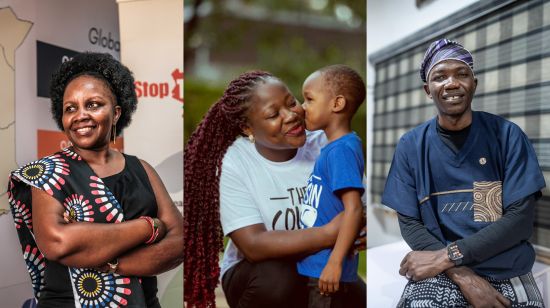
From L to R: Evaline Kibuchi, Robinah Babirye with her son, and Semiye Michael Larayetan
Why does our foundation invest in the Global Fund to Fight AIDS, Tuberculosis and Malaria? Because it works.
Since 2002, the Global Fund has helped save an estimated 70 million lives by supporting country-led efforts to prevent, treat, and reduce the devastating impact of HIV/AIDS, tuberculosis (TB), and malaria on communities worldwide. The Global Fund is a smart investment because it reduces the global spread of infectious disease, stabilizes economies, and strengthens health systems that are the first line of defense against future pandemics.
It works by bringing together governments, civil society organizations, communities, philanthropies, and the private sector to pool global resources. In partnership, they help improve access to care, support innovative tools and approaches that meet local needs, and ultimately drive down infections. This model of global cooperation, which also requires recipient countries to commit domestic financing to augment Global Fund grants, really works.
Lives behind the numbers
Behind every statistic are real people facing HIV, TB, and malaria with resilience. Explore their stories:
I’ve seen this impact firsthand. When I began my career 25 years ago, there was no Global Fund—no coordinated way to reduce drug prices, scale up preventive measures, or ensure that lifesaving treatments reached the people who needed them most. Infection rates were staggeringly high. That has all changed.
“The Global Fund is a smart investment because it reduces the global spread of infectious disease, stabilizes economies, and strengthens health systems…
Today, countries use Global Fund support to roll out faster diagnostic tests for TB, expand access to antiretroviral treatment for HIV, and adapt to new challenges like drug-resistant infections.
Still, I’m worried. The world is at a crossroads. Without continued investment in the Global Fund, 20-plus years of progress could unravel. Infections could rise. Costs could climb. And, ultimately, more lives could be lost.
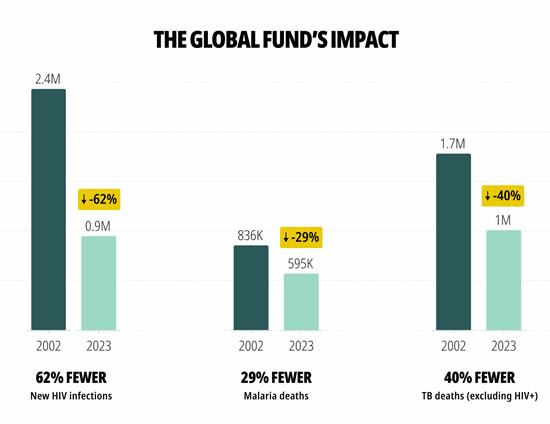
The Global Fund has helped lead to fewer new HIV infections, fewer malaria deaths, and fewer TB deaths. Source: The Global Fund
In 2024 alone, the Global Fund helped 25.6 million people gain access to HIV treatment, supported 7.4 million people in receiving TB care, and helped distribute more than 162 million mosquito bed nets. Countries are rapidly transitioning to a new type of bed net that is up to 50% more effective against insecticide-resistant mosquitoes and helped avert an estimated 13 million malaria cases between 2019 and 2022. This kind of innovation, coupled with partnership and community engagement, translates into real progress.
But the numbers tell only part of the story. Behind every statistic are real people who face the challenges of these diseases and build the resilience needed to overcome them. They remind us why continued investment in organizations like the Global Fund is so essential.
–Cynthia Mwase, Director, Health, Africa, Gates Foundation
Behind the statistics: Stories of resilience
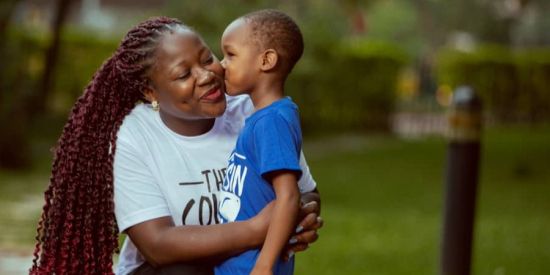 Robinah Babirye with her son in Uganda. Photo credit: Robinah Babirye
I was waiting for the results of my baby’s HIV test, and my heart was beating in my throat.
We mothers with HIV must follow a very strict set of rules so our babies stay healthy. When your baby is born, the doctors tell you whether you can breastfeed exclusively or use formula or dairy milk. We were told you can’t mix. You must choose one. I was told [that] because I had a suppressed viral load, the transmission risk was negligible. Breastfeeding was the best choice. It was also because I could not afford to buy dairy milk or formula.
But four months later, I panicked. My baby wasn’t getting enough to eat. I went to the doctor hoping she would give me a supplement to boost my breast milk.
She looked at my records, clicked a few buttons on the computer, and smiled. “You can mix the milk,” she said. I’m like, “What?”
Mixing breast milk and formula is something we were told never to do. They said it could irritate the baby’s gut lining and increase the risk of HIV transmission even if your viral load is low.
I knew mothers who mixed, and their babies contracted HIV. I kept asking her, “Are you sure?” All I wanted was to keep my baby healthy. I did what she told me, but I was so very anxious. I looked forward to the next HIV test for my baby. When the test was done, I was told to wait until my next appointment, which was three months later, to get the results. All blood work must go through the national lab for processing first before the results are received.
Two months later, I got a call from the nurse, and she told me, “Your baby’s results are back, and I don’t want to keep you waiting.” She sent the results through a text message. My hands were shaking. A tornado was happening in my belly. As I opened it, I was wondering, “Had I made the right choice for my baby?”
Then came relief. HIV negative. Finally, I could breathe.
Babirye’s experience underscores the importance of accessible care and accurate guidance for mothers living with HIV. The Global Fund is working to ensure this by supporting country-led programs that expand access to treatment, improve health systems, and offer mothers the information they need.
The science around transmission has evolved, and it’s important we mothers understand it. That’s why I share everything I’ve learned.
Now I know: If your viral load is fully suppressed and both mother and baby are taking antiretrovirals, doctors may allow you to mix feeding in certain cases.
Today, when my fellow mothers in Uganda are anxious, I listen. I share what I know. And I say, “One day, you’re going to look into your baby’s eyes and feel proud. No one can do a better job than you.”
Nigeria
A nonprofit leader learns a lesson in a small village
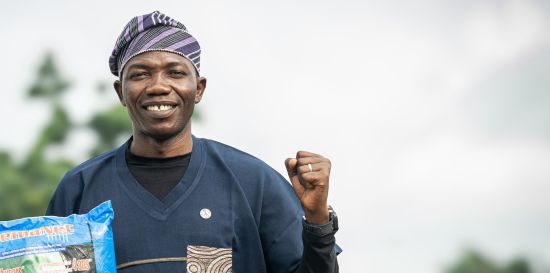
Semiye Michael Larayetan
Semiye Michael Larayetan photographed in Nigeria. ©Gates Archive/Brian Otieno
I’m the guy that loves making good things happen to people even when they don’t think [they] will. I love that heroic feeling.
A few years ago, my friends and I started the One Kid Project to bring education supplies and learning opportunities to children in hard-to-reach rural communities in Nigeria. We were looking forward to visiting Kwalita Village.
Driving there, it rained heavily, and the road was terrible. Our excitement started to disappear. We arrived exhausted and hungry. The houses were mud, with leaky grass roofs. The smell of cow dung was so thick it stung.
Suddenly, there was a crowd of women around us. “Have you brought malaria nets?” they asked. I said, “No, we brought school supplies.” All of them started shouting. “Our children are dying of malaria. We want malaria nets!”
They nearly chased us away, and we felt rejected with our good intentions. But first, they took us to a small graveyard, with tiny graves no bigger than a heap of sand. This is where they buried their children who had died of malaria. We spent the next six hours driving back home, frustrated and shaken.
Larayetan’s story illustrates the importance of listening to communities and responding to their needs. The Global Fund’s approach in Nigeria centers on community engagement and partnership—working with local leaders to distribute innovative malaria prevention tools, strengthen health systems, and ensure that solutions reach those who need them most.
Later, I thought about my own home village, where there are still so many needs. The women of Kwalita were brave enough to confront us with their need. The problem was, we didn’t have malaria nets or money to get them. We spent three frustrating weeks searching for them. Finally, out of frustration, I put a message on my Facebook narrating the ordeal, and a friend saw it and said an organization could help us with 300 nets!
As we drove back into Kwalita Village, I jumped to my feet and began waving a net from the Jeep. The women came rushing out. Now we were able to give all 60 families the protection they needed, rather than what we thought they needed.
Since then, my friends and I have helped distribute many more nets. We fundraise and bring clean water to communities and continue to distribute school supplies. That heroic feeling I enjoy? That’s what inspires the things I do. I’m serving others, and I love the way it makes me feel.
Kenya
A friend channels her grief into TB advocacy
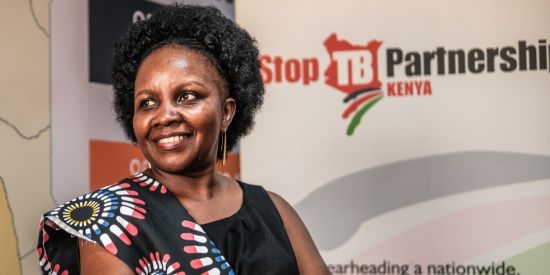
Evaline Kibuchi
Evaline Kibuchi photographed in Kenya. ©Gates Archive/Brian Otieno
The frantic call came as I drove to Nairobi: “There’s a patient at the hospital who needs your attention.” I’m a TB advocate, not a medical doctor. Why would any patient need my attention?
When I got to the hospital, I understood. It was Luceta, my friend of 10 years. We met when she was undergoing treatment. An injection a day for six months, plus a bowl of tablets every day for 24 months, to fight multidrug-resistant TB. She had to leave her teaching job and relocate to the city to access treatment, at great cost. Years ago, some people said they’d rather die than endure it, but Luceta became an advocate. She was determined to ensure others didn’t have to go through what she did.
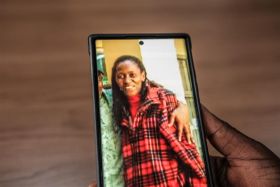 A photo of Luceta. A photo of Luceta.
Photo credit: Evaline Kibuchi
Her TB was cured, but the complications never left her. Now, at Kenyatta National Hospital, her eyes were white and her lips were dry. I ran to a doctor and grabbed his white coat. “You have to save Luceta,” I told him. She had traveled 300 kilometers to attend a World TB Day event. We were both scheduled to speak the next day, but now she was looking very frail.
I held Luceta’s hand as she struggled, coughing blood. The last thing she said before I left was, “Evaline, this time I don’t think I’m going to make it.” It was well after midnight when I received the dreaded call. I had lost my friend.
When morning came, I took the podium and stood in front of hundreds of people, members of parliament, stakeholders, donors, the entire TB fraternity. Shaking, I pointed at the seat where Luceta was supposed to sit and said, "Luceta won't be speaking today. We lost her." The room fell silent. What killed Luceta, I told them, wasn’t the tuberculosis. It was complications that remain after such long-term treatment. From that day, I decided to focus on post-TB complications.
Kibuchi’s advocacy highlights the need for care that extends beyond TB treatment. The Global Fund is addressing this need in Kenya by supporting patient groups and community-led interventions, advocating for comprehensive TB care in national policies, and investing in innovations and social protection measures.
Now, 17 years after Luceta first became ill, things have changed. We don’t wait six months for diagnosis; treatment is shorter, with fewer side effects, and you don’t have to relocate to receive it. Social protection helps patients complete their treatment. And now, post-TB complications are included in most countries’ national plans, including Kenya’s.
Advocates like Luceta helped teach all of us—from local communities to members of parliament—that TB treatment does not end with the last pill.
Today, I share stories of people like Luceta to help advocate for domestic funding for TB and post-TB treatment. But TB still kills more than 1 million people each year and disables millions more.
Luceta fought her fight when she was living. I continue to fight her fight after her death.
Media Relations
Gates Foundation
Media@gatesfoundation.org
Source: Gates Foundation
https://www.gatesfoundation.org/ideas/articles/global-fund-impact-stories
"Reproduced with permission - Gates Foundation"
Gates Foundation
Back to ...
Positively Positive - Living with HIV/AIDS:
HIV/AIDS News
For more HIV and AIDS News visit...
Positively Positive - Living with HIV/AIDS: HIV/AIDS News Archive
|