|
Leaders’ failure to fully replenish Global Fund threatens decades of progress against HIV, TB, and malaria
The funding target must be met this week to prevent catastrophic cuts and soaring costs for patients who can’t afford to pay high prices for medicines.
November 17, 2025

Christine Muntali, MSF's sexual and reproductive health nurse supervisor, administers a contraceptive, medroxiprogesterona, for a patient who is a sex worker. | Malawi 2023 © Diego Menjibar
Ahead of the Global Fund to Fight AIDS, Tuberculosis (TB) and Malaria’s Eighth Replenishment Summit in Johannesburg, South Africa, this week, Doctors Without Borders/Médecins Sans Frontières (MSF) is calling for world leaders to meet the Global Fund’s $18 billion target.
Failure to meet this goal would risk catastrophic cuts to essential services, threaten the resurgence of HIV, TB, and malaria—the world’s top three deadliest infectious diseases—and put the financial burden of health care onto the world’s most vulnerable patients.
The high-level fundraising meeting—on funding the program for 2027-2029—will take place on November 21, on the sidelines of the G20 Leaders’ Summit. In many countries, the Global Fund is the main financier and procurer of HIV, TB, and malaria products, directly influencing resources, strategies, and people’s access to care. MSF projects often depend on these supplies.
“The international community cannot afford to falter now … When funding falls short, it is the patients—those least able to afford care—who pay the price.”
Tess Hewett, MSF health policy advisor
The consequences of failing to meet the $18 billion target would be severe and immediate. If countries don’t pledge enough funds, vital work such as support for data collection systems that monitor disease spikes and where people are getting care would suffer. Cuts could also severely impact the global TB response, as the Global Fund currently supports 76 percent of the worldwide donor response for TB. In addition, the adoption of promising new medical products, such as new TB vaccines, existing malaria vaccines, and new HIV prevention tools like lenacapavir, would be limited.
“The international community cannot afford to falter now,” said Tess Hewett, health policy advisor for MSF. “We are seeing major traditional donors signaling deep cuts, even as the need for sustained investment grows. When funding falls short, it is the patients—those least able to afford care—who pay the price.”
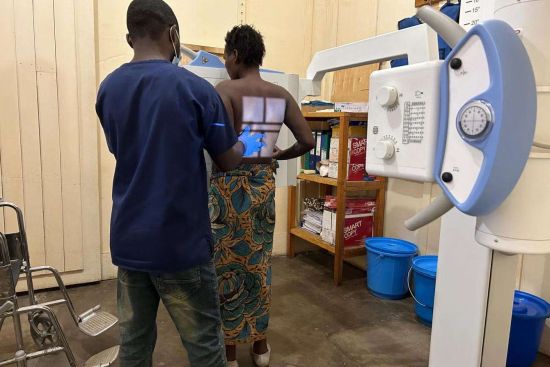
A radiology technician prepares a patient for an X-ray for potential pulmonary tuberculosis (TB) at the general referral hospital of Mweso, North-Kivu. | DR Congo © Laora Vigourt/MSF
Insufficient funds shift the burden onto vulnerable people
Delays in finalizing pledges after November 21 could compromise effective program planning.
When funding is insufficient, the financial burden is often shifted onto vulnerable communities through an emphasis on increasing “domestic resource mobilization.” While this is envisaged as an increase in health spending by national governments, in reality this shift frequently results in a hike in out-of-pocket payments by people themselves. This is particularly true in low-income countries.
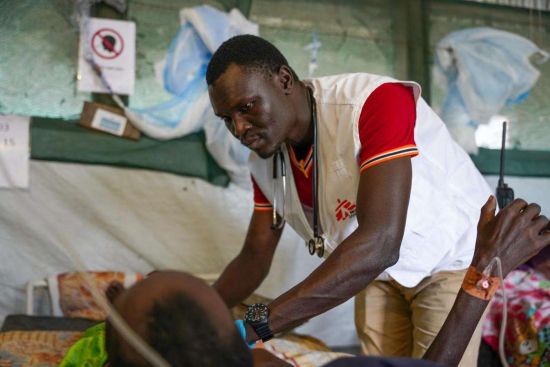
Dr. Isaac Batali examines a patient in the inpatient department at MSF's hospital in Lankien, Jonglei state. | South Sudan 2022 © Paul Odongo/MSF
Initial pledges for this replenishment have been deeply concerning. Germany and the United Kingdom—the only major traditional donors to pledge so far—have both decreased their commitments compared to the last cycle. Specifically, Germany has pledged $1.1 billion instead of $1.5 billion and the UK has pledged $1.1 billion instead of $1.3 billion. No donor has increased their pledge when considering inflation. If other major donors follow Germany and the UK’s examples, the results would be catastrophic for people impacted by TB, HIV, and malaria worldwide.
In many countries, the Global Fund is the main financier and procurer of HIV, TB, and malaria products, directly influencing resources, strategies, and people’s access to care. MSF projects often depend on these supplies.
“We urge the remaining big donors to heed the evidence contained in MSF’s "Deadly Gaps" report and commit fully on November 21,” Hewett said. “To accelerate progress toward the UN’s Sustainable Development Goal 3 and end TB, HIV, and malaria as public health threats, the Global Fund needs the full $18 billion. With the right resources, the Global Fund believes it could save 23 million lives and halve the death toll in just six years.”
Source: https://www.doctorswithoutborders.org/latest/leaders-failure-fully-replenish-global-fund-threatens-decades-progress-against-hiv-tb-and
Contact
Claudia Blume
Claudia.Blume@toronto.msf.org
"Reproduced with permission - Doctors Without Borders / Médecins Sans Frontières (MSF)"
Doctors Without Borders / Médecins Sans Frontières (MSF)
Back to ...
Positively Positive - Living with HIV/AIDS:
HIV/AIDS News
For more HIV and AIDS News visit...
Positively Positive - Living with HIV/AIDS: HIV/AIDS News Archive
|