Researchers uncover how a killer fungus quietly invades the brain
By Shantell M. Kirkendoll
December 11, 2025
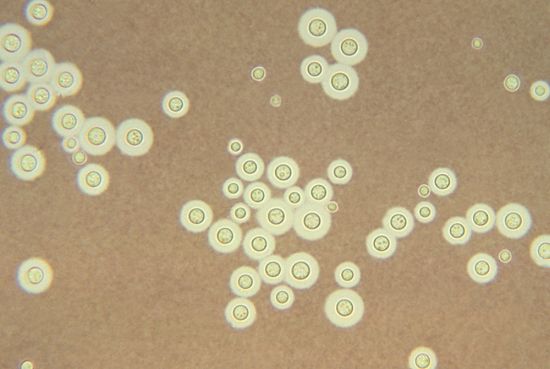
Study highlights a potential new way to boost the immune system against Cryptococcus, a World Health Organization “critical priority” fungus whose reach is expanding as climate change and global travel accelerate its spread. (CDC Image Bank)
A deadly fungus known for causing severe brain infections in people with weakened immune systems may be sneakier than scientists realized, according to a Duke University School of Medicine study.
Cryptococcus causes hundreds of thousands of infections each year and is a leading cause of death among people with HIV/AIDS. The fungus can reach the brain just one day after entering the bloodstream, but the brain’s frontline defenders — microglia — remain largely inactive for nearly two weeks.
“Microglia eventually do respond, but they wake up far too late,” said the study’s lead author Mari Shinohara, PhD, senior study author and professor in the Department of Integrative Immunobiology.
The work funded by the National Institutes of Health, with support from the Duke SOM Precision Genomics Collaboratory-OBGE Graduate Student Pilot Research Grant, points to a surprising vulnerability in the brain’s immune defenses.
In their Cell Host & Microbe study, Shinohara and postdoctoral researcher Estefany Reyes, PhD, used mouse models to show that microglia struggle to detect the fungus on their own. Instead, they depend on T cell signals, including the molecule interferon-gamma, to sound the alarm.
By the time microglia do respond, they release large amounts of osteopontin, a protein that may worsen the infection.
“Because microglia can play both helpful and potentially harmful roles, understanding how to guide their responses will be important,” Shinohara said.
The findings reveal a fungus that thrives by exploiting the brain’s slow-to-react immune landscape, and they hint at new strategies for treatment. While antifungal drugs directly target the pathogen, Shinohara said the study suggests a complementary path: adjusting the brain’s own immune response.
“In the future, pairing antifungal drugs with approaches that gently modulate microglial activity may offer better outcomes for people with cryptococcal meningitis,” she said.
Her team now plans to identify the exact signals that rouse microglia and explore how to encourage protective responses without triggering harmful inflammation.
Media Contact:
Jason Kravitz
jason.kravitz@duke.edu
Source: Duke University School of Medicine
https://medschool.duke.edu/news/researchers-uncover-how-killer-fungus-quietly-invades-brain
"Reproduced with permission - "Duke University School of Medicine"
Duke University School of Medicine
Back to ...
Positively Positive - Living with HIV/AIDS:
HIV/AIDS News
For more HIV and AIDS News visit...
Positively Positive - Living with HIV/AIDS: HIV/AIDS News Archive
|