McMaster Discovery Could Lead to New Treatments for Drug-Resistant Fungal Infections
By Blake Dillon
January 7, 2026
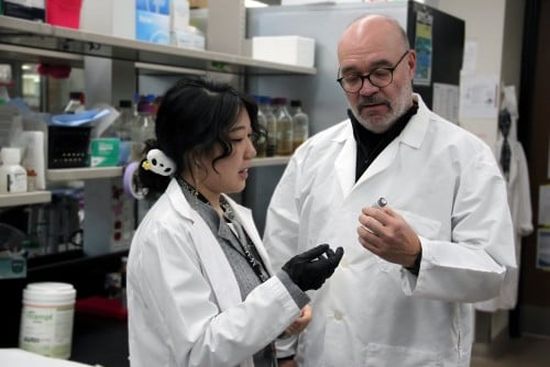
Postdoctoral fellow Xuefei Chen and Professor Gerry Wright discovered “a legitimate drug candidate,” but also “an entirely new target to attack with other new drugs.”
Fungal infections kill millions of people each year, and modern medicine is struggling to keep up. But researchers at McMaster University have identified a molecule that may help turn the tide — butyrolactol A, a chemical compound that targets a deadly, disease-causing fungi called Cryptococcus neoformans.
Infections caused by Cryptococcus are extremely dangerous. The pathogen, which can cause pneumonia symptoms, is notoriously drug-resistant, and it often preys on people with weakened immune systems, like cancer patients or those living with HIV. And the same can be said about other fungal pathogens, like Candida auris or — both of which, like Cryptococcus,have been declared priority pathogens by the World Health Organization.
Despite the threat, though, doctors have only three treatment options for fungal infections.
The gold standard is a drug class called amphotericin — though Gerry Wright, a professor in McMaster’s Department of Biochemistry and Biomedical Sciences, jokes that it’s often called “amphoterrible,” because of the major toxic side-effects that it has on humans.
“Fungal cells are a lot like human cells, so the drugs that hurt them tend to hurt us too,” he says. “That’s why there are so few options available to patients.”
The other two antifungal drug classes that are available — azoles and echinocandins — are much less effective treatment options, especially against Cryptococcus . Wright says azoles merely stop fungi from growing rather than outright killing them, while Cryptococcus and other fungi have become totally resistant to echinocandins, rendering them completely ineffective.
So, with a stagnant antifungal drug pipeline, a limited arsenal of approved medicines, and rising rates of drug resistance, scientists are now betting on something called “adjuvants” as a solution to the growing health threat.
“Adjuvants are helper molecules that don’t actually kill pathogens like drugs do, but instead make them extremely susceptible to existing medicine,” explains Wright, a member of the Michael G. DeGroote Institute for Infectious Disease Research (IIDR).
Looking for adjuvants that might better sensitize Cryptococcus to existing antifungal drugs, Wright’s lab screened McMaster’s vast chemical collection for candidate molecules.
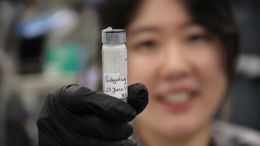
Postdoctoral fellow Xuefei Chen holds a vial of butyrolactol A, which she discovered can work in tandem with other medicine to attack otherwise drug-resistant fungi.
Quickly, his team founda hit: butyrolactol A, a known-but-previously-understudied molecule produced by certainStreptomyces bacteria. The researchers found that the molecule could synergize with echinocandin drugs to kill fungi that the drugs alone could not.
But they had no idea how it worked — and almost didn’t bother to find out.
“This molecule was first discovered in the early 1990s, and nobody has ever really looked at it since,” Wright says. “So, when it showed up in our screens, my first instinct was to walk away from it. I thought, ‘it’s a known compound, it kind of looks like amphotericin, it’s just another toxic molecule —not worth our time.’”
But he credits the determination of postdoctoral fellow Xuefei Chen for changing his mind.
“Early on, this molecule’s activity appeared to be quite good,” says Chen, who works in Wright’s lab. “I felt that if there was even a small chance that it could revive an entire class of antifungal medicine, we had to explore it.”
After years of what Wright calls& “painstaking sleuthing and detective work” led by Chen, the research team revealed exactly how the adjuvant worked.
Chen discovered that butyrolactol A acts as a plug that clogsup an important protein complex that’s “mission critical” for Cryptococcus — “when it’s jammed, all hell breaks loose,” Wright says. This disturbance renders the fungus completely vulnerable to the drugs that it also functions similarly in Candida auris which gives it broad clinical potential.
Wright says the findings, published recently in the prestigious journal Cell, are more than a decade in the making.
“That first screen that put butyrolactol A on our radar took place in 2014,” he notes. “More than eleven years later, thanks almost entirely to Chen, we have identified a legitimate drug candidate and an entirely new target to attack with other new drugs.
The discovery marks the second antifungal compound and the third new antimicrobial found by Wright’s lab in the past year.
Contact:
Michelle Donovan
donovam@mcmaster.ca
McMaster University
"Reproduced with permission - McMaster University "
McMaster University
Back to ...
Positively Positive - Living with HIV/AIDS:
HIV/AIDS News
For more HIV and AIDS News visit...
Positively Positive - Living with HIV/AIDS: HIV/AIDS News Archive
|