Redesigned Hepatitis C Drug Becomes a Powerful New Treatment for COVID-19
Scientists transformed an old drug into a potent COVID-19 treatment effective against drug-resistant variants.
19-Feb-2026 by Department of Energy, Office of Science
Credit: Image courtesy of Stanford University
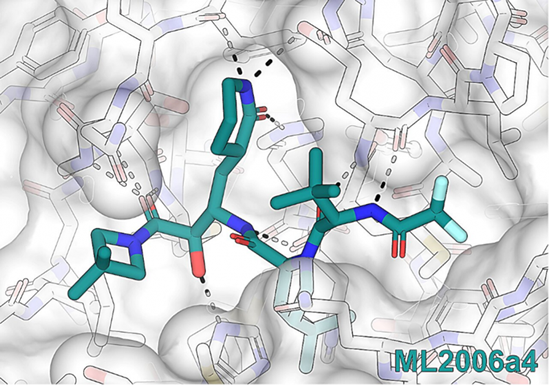
The final version of the redesigned drug binds tightly to the main COVID-19 protease, an enzyme the virus needs to multiply. The drug’s structure is effective even against mutated forms that resist other treatments.
The Science
Newswise — Researchers have redesigned the hepatitis C drug boceprevir to create a more effective treatment for COVID-19. Some virus variants no longer respond well to current therapies, like Paxlovid, due to mutations in the main COVID-19 virus protease (Mpro). This is a key enzyme the virus uses to replicate. Mpro is essential to the virus and remains intact from variant to variant. As such, it is an ideal target for treatments to focus on. Using X-ray crystal structures, scientists refined boceprevir atom by atom. They worked to improve how the drug binds within key pockets of the enzyme. The researchers used the Stanford Synchrotron Radiation Lightsource (a DOE Office of Science User Facility) to analyze the crystal structure when the drug was attached to Mpro.
The Impact
This research produced a drug that is effective against COVID-19 strains that are resistant to existing treatments. The resulting compound, ML2006a4, binds more tightly and durably than earlier drugs. It also shows superior protection in preclinical animal studies. By redesigning an older hepatitis C drug, scientists made it more effective against mutated forms of the virus’s protease. This could help doctors treat patients who no longer respond to existing therapies.
Summary
Boceprevir is a protease inhibitor originally developed to treat hepatitis C. Scientists adapted this drug to target the main protease (Mpro) of SARS-CoV-2. This is a critical enzyme the virus uses to process its polyproteins and replicate. Because Mpro is conserved across variants and has no close human equivalent, it remains a prime target for antiviral drug development. However, some SARS-CoV-2 variants contain mutations in Mpro that reduce the effectiveness of existing treatments.
Using X-ray crystallography data collected at the Macromolecular Crystallography Beamlines at the Stanford Synchrotron Radiation Lightsource (SSRL), researchers determined high-resolution structures of Mpro bound to various boceprevir analogs. These structural insights guided a stepwise redesign of the molecule to improve its fit within the enzyme’s active site and sub-pockets. The team optimized interactions and reduced internal strains within the drug’s structure to improve binding, potency, and resistance profile.
The final compound, ML2006a4, binds covalently to Mpro and retains strong activity even against variants harboring resistance-associated mutations. This structure-guided approach demonstrates how iterative design can yield next-generation antivirals with broad-spectrum activity. It also underscores the vital role of DOE- and NIH-supported synchrotron-based methods in accelerating drug discovery against emerging viral threats.
Funding
Funding for this research included: Sarafan ChEM-H and the Innovative Medicines Accelerator, Harrington Scholar-Innovator Award, Emergent Ventures at the Mercatus Center at George Mason University, Stanford-Coulter Translational Research Grant, National Institute of Health(NIH)/National Institute of Allergy and Infectious Diseases (NIAID) Antiviral Drug Discovery (AViDD) Center, the Denver Foundation, the Novo Nordisk Foundation, the Stanford Bio-X Program and a Bio-X Interdisciplinary Graduate Student Fellowship, E&M Foundation Postdoctoral Fellowship, Postdoctoral Fellowship in Translational Medicine from the PhRMA Foundation and an anonymous donation to establish the Stanford BSL3 facility. The research used resources at SSRL, a DOE Office of Science user facility, and of the SSRL Structural Molecular Biology Program supported by the DOE Office of Biological and Environmental Research and by NIH National Institute of General Medical Sciences.
Source: https://www.newswise.com/articles/redesigned-hepatitis-c-drug-becomes-a-powerful-new-treatment-for-covid-19
Back to ...
Positively Positive - Living with HIV/AIDS:
HIV/AIDS News
For more HIV and AIDS News visit...
Positively Positive - Living with HIV/AIDS: HIV/AIDS News Archive
|