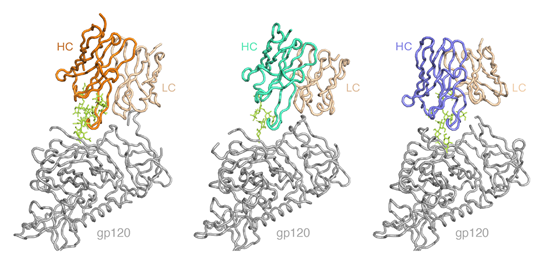
Cryo-EM structure of BG18 bnAb bound to HIV gp120, used to guide vaccine design (left). Cryo-EM structures of two BG18-class bnAbs induced by vaccination in non-human primates bound to HIV gp120 (right). Credit: Scripps Research
Scripps Research scientists train the immune system to make antibodies against numerous HIV strains
Preclinical findings mark progress toward a long-sought vaccine capable of broad protection against HIV.
July 06, 2026
LA JOLLA, CA—HIV is globally so diverse, consisting of hundreds of thousands of different strains, that antibodies capable of blocking one strain may not recognize another. This strain variability has been one of the greatest barriers to developing a vaccine that can provide broad protection against the virus. But rather than hoping the immune system stumbles onto the right antibodies, scientists at Scripps Research and collaborating institutions designed a series of immunizations to guide a subset of precursor B cells—white blood cells that can mature into cells that release antibodies—through a step-by-step training process termed germline-targeting sequential immunization. Each successive shot was engineered to activate the appropriate B cells and then nudge them closer to producing broadly neutralizing antibodies (bnAbs): rare antibodies that are able to recognize and block many different HIV strains.
For the first time, in a preclinical study of this vaccine strategy in non-human primates, the regimen generated functional bnAbs in serum, meaning the antibodies could neutralize many strains of HIV in laboratory tests. The findings, from scientists across Scripps Research, the La Jolla Institute for Immunology (LJI), Emory University, IAVI and other institutes, published in Nature on June 30, 2026, provide proof of principle for the germline-targeting strategy, showing that the immune system can be steered toward bnAbs that are expected to provide broad protection against HIV.
These antibodies were “made to order” in the sense that they recognized the exact site on HIV that the researchers set out to target—and approached it at the intended angle. They also carried genetic features that the team had prespecified.
“For years, a major question in HIV vaccine research has been whether we could guide the antibody-maturation process through multiple stages to a desired end result,” says the study’s co-senior author, Scripps Research professor William Schief, who’s also the vice president of protein design in infectious disease research at Moderna, Inc. and the executive director of vaccine design at IAVI’s Neutralizing Antibody Center. “This work shows that the strategy can function as intended.”
Earlier clinical trials led by Schief and his colleagues determined that germline targeting could consistently activate rare precursor B cells with the potential to become bnAb producers. A paper they published in 2025 then found that a follow-up booster immunization could move those cells further along the coveted path in clinical trials. However, those studies hadn’t yet produced mature, functional bnAbs.
Such antibodies have long attracted interest because they can recognize parts of HIV that remain relatively similar across various strains. Some people naturally develop bnAbs after years of infection, but conventional HIV vaccination approaches haven’t been able to reliably induce them.
Most former HIV vaccine candidates presented the immune system with versions of the virus’s outer “envelope” protein (HIV Env) and relied on the right antibody response to emerge. That strategy faces an unusual obstacle: the rare precursor B cells generally don’t recognize natural HIV Env well enough to be activated and eventually produce the right bnAbs.
Germline targeting takes a more directed approach. The first stage, called priming, uses an engineered vaccine component designed specifically to find and activate rare precursor B cells. Later boosters expose the cells to progressively more natural and diverse versions of HIV Env, encouraging them to accumulate the mutations needed to bind to the virus more tightly and recognize a wider range of strains. The regimen tested in this study focused on BG18, a particularly potent bnAb that targets a vulnerable region on HIV’s surface.
The study also used saponin/MPLA nanoparticles (SMNP), an adjuvant developed by Howard Hughes Medical Institute Investigator Darrell Irvine, a professor and the Lita Annenberg Hazen Chair at Scripps Research. Adjuvants are typically added to protein-based vaccines to strengthen the immune response, and SMNP was likely critical to the study’s success.
“Activating rare precursor B cells was the starting point,” notes co-first author Jon Steichen, an institute investigator at Scripps Research. “Each new immunization had to keep the BG18-class cells engaged while asking them to recognize a more difficult and realistic version of HIV Env.”
The project began by testing three candidates for the first booster. When all three successfully reactivated the targeted cells, the team extended the study to see how far it could take the response. The researchers tracked immune responses for over two years as they tested a priming phase followed by seven boosters, with comprehensive B cell analyses led by co-first author Patrick Madden, an instructor in the laboratory of co-corresponding author Shane Crotty, a professor and the chief scientific officer at LJI. Throughout that period, the targeted classes of B cells continued to survive and accumulate mutations that improved their ability to recognize diverse HIV variants.
After the fifth booster, 78% of primates receiving the sequential regimen still had detectable BG18-class responses. High-resolution structural imaging by the laboratory of Scripps Research professor Andrew Ward confirmed that the antibodies were binding to HIV Env as intended, rather than reaching the same target through an unplanned route.
More than half of the group receiving the full regimen developed bnAb lineages capable of blocking multiple HIV strains. One of the most important results came after the final booster, which displayed HIV proteins on nanoparticles. That shot helped prompt mature memory B cells to become plasma cells—immune cells that release large quantities of antibodies into the bloodstream.
“We were encouraged that the desired antibody lineages didn’t fade away during repeated rounds of vaccination,” recalls co-author Dennis Burton, a professor and the James & Jessie Minor Chair in Immunology at Scripps Research. “Instead, they continued to mature, and in many cases developed bona fide bnAbs in serum, a strong indicator of protection against HIV following exposure.”
Following the final booster, bnAb activity was detected in the serum of 44% of primates receiving the regimen—a key finding because protective antibodies ultimately need to circulate via the bloodstream, where they can encounter and block HIV. In the strongest response, the serum antibodies could neutralize an estimated 52% of HIV strains represented in standard global panels, at levels that previous research suggests could provide substantial protection. However, the study didn’t test whether the vaccine regimen prevented infection.
Still, significant work remains before the strategy can lead to a practical vaccine. Although the priming immunogen is already being tested in humans, the regimen tested in this study required multiple shots over an extended period, making it too complex and lengthy for real-world use. Next on the agenda is to shorten the sequence without losing the antibody response. The researchers also want to make the strongest results more consistent and determine how long bnAbs remain at protective levels in the blood before advancing the full regimen into clinical trials.
Despite the work that remains, the findings could have significant implications beyond HIV.
“Our work represents both an HIV vaccine milestone and a broader test of germline-targeting vaccine design,” points out Schief. “It indicates that vaccines can be built as a sequence of instructions that deliberately guides antibody evolution, which is an approach that may also be useful against other pathogens whose rapid variation makes them difficult to target.”
In addition to Schief, Irvine, Steichen, Madden, Crotty, Ward and Burton, authors of the study, “Vaccination elicits HIV broadly neutralizing antibodies in primates,” include Swastik Phulera, Oleksandr Kalyuzhniy, Alessia Liguori, Leigh M. Sewall, Christopher A. Cottrell, Krystal M. Ma, Sabyasachi Baboo, Jolene K. Diedrich, Nicole Phelps, Danny Lu, Diana Goodwin, Ryan Tingle, Yumiko Adachi, Nushin Alavi, Jenny Tran, Andy S. Tran, Daniel L. V. Bader, Grace Pixton, Agnes Walsh, Mariane B. Melo, Torben Schiffner, James C. Paulson, John R. Yates III and Gabriel Ozorowski of Scripps Research; Monolina Shil, Ivy Phung, Parham Ramezani-Rad, Ester Marina-Zárate and Brian Freeman of LJI; Claudia T. Flynn, Carolyne Kifude, Katherine McKenney, Jeong Hyun Lee, Troy Sincomb, Hannah Voic and Xiaoya Zhou of IAVI; Allan C. deCamp of the Fred Hutchinson Cancer Center; Diane G. Carnathan, Alyne Nascimento, Catherine Sovie and Guido Silvestri of Emory University; and Zhenfei Xie and Facundo D. Batista of the Ragon Institute of Mass General Brigham, MIT, and Harvard.
This work was supported by funding from the National Institute of Allergy and Infectious Diseases (grants UM1 Al100663, UM1 AI144462, P51 OD011132, R01 AI113867 and S10OD025052); and the Gates Foundation under the Collaboration for AIDS Vaccine Discovery (grants NAC INV-007522, INV-008813, INV-034657 and INV-064772, via IAVI).
Contact:
Anna Andersen
Marketing & Communications
Scripps Research
Scripps Research Translational Institute
Press: press@scripps.edu
Source: Scripps Research
https://www.scripps.edu/news-and-events/press-room/2026/20260706-schief-nature.html
“Reproduced with permission - Scripps Research”
Scripps Research
Back to…
Positively Positive - Living with HIV/AIDS:
HIV/AIDS News
For more HIV and AIDS News visit…
Positively Positive - Living with HIV/AIDS: HIV/AIDS News Archive
|